March 12, 2022
Work in progress
Usage
Maven POM
The following dependency includes the AIKA software library to an existing maven project.
<dependency>
<groupId>network.aika</groupId>
<artifactId>aika</artifactId>
<version>2.0.3-SNAPSHOT</version>
</dependency>
Artificial example with Input Tokens ABCD
Example showing three pattern neuron ensembles and a mutual exclusion circuit. The mutual exclusion circuit leads to two separate branches that are shielded from one another. The diamond shaped arrows indicate feedback synapses. When an activation is split due to branching, the branch relation is shown by the orange dashed arrow. The SamePatternLink connecting the BindingNeurons of a pattern neuron ensemble is used to verify the relation between the input features these two BindingNeurons represent within the pattern.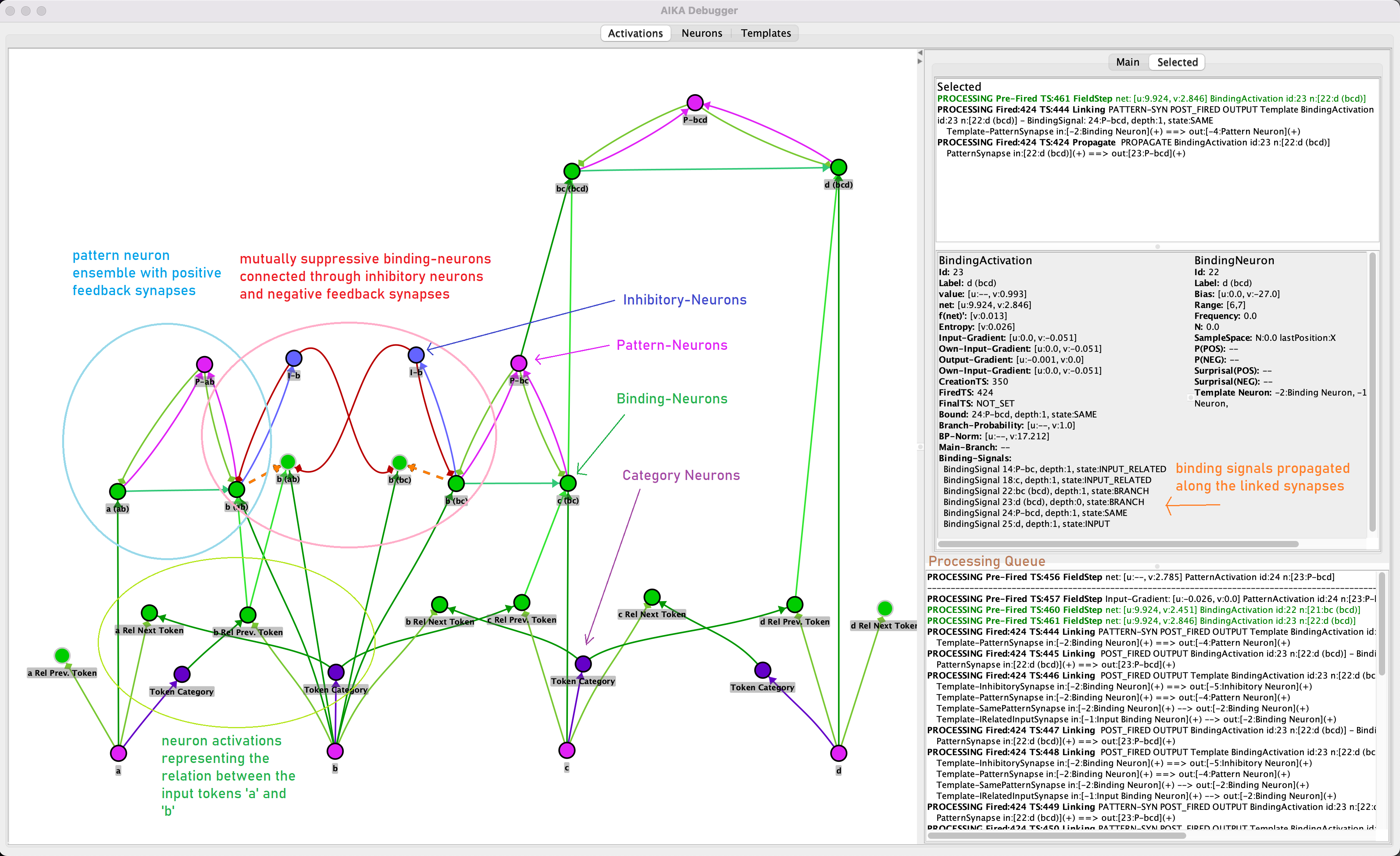
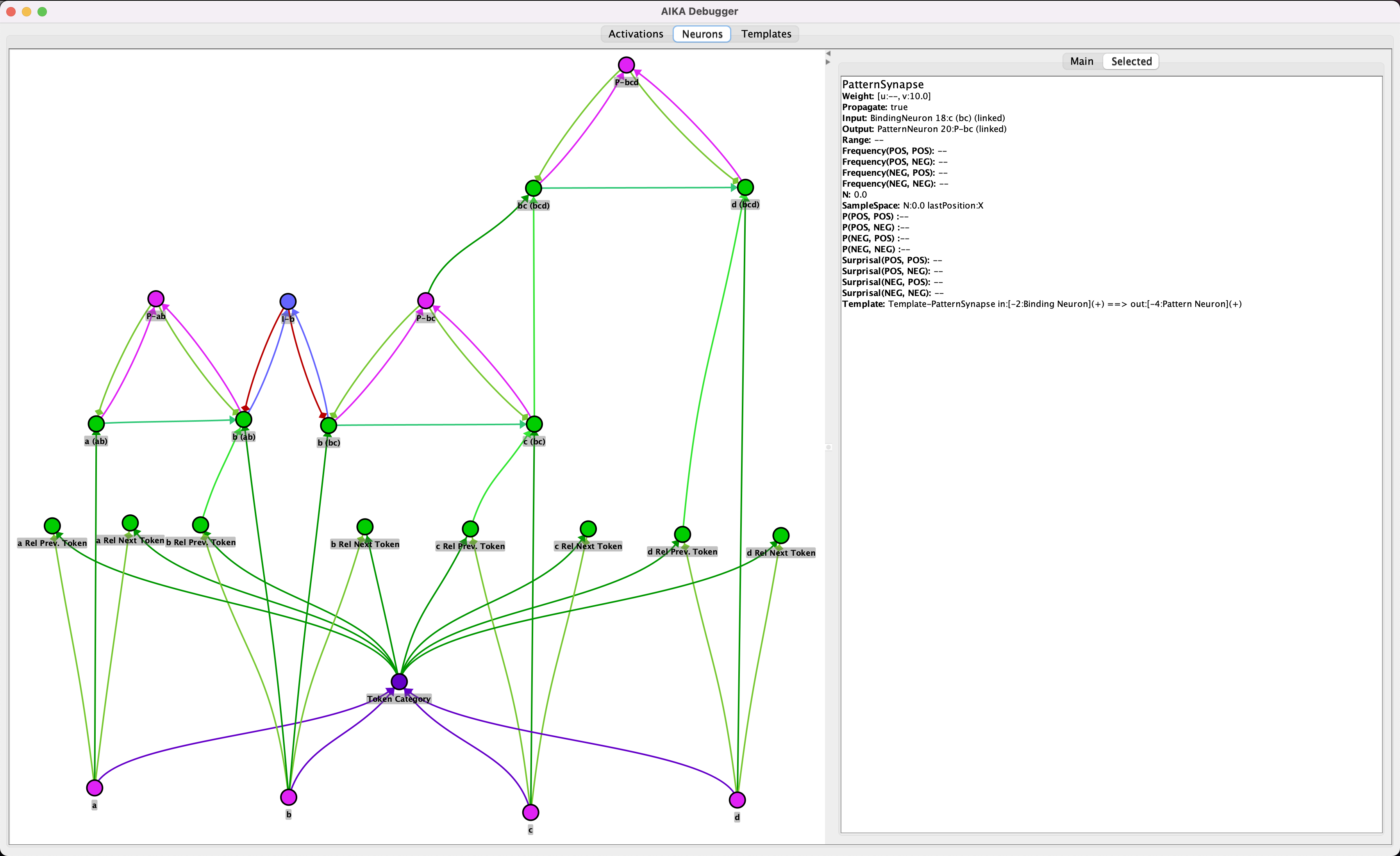
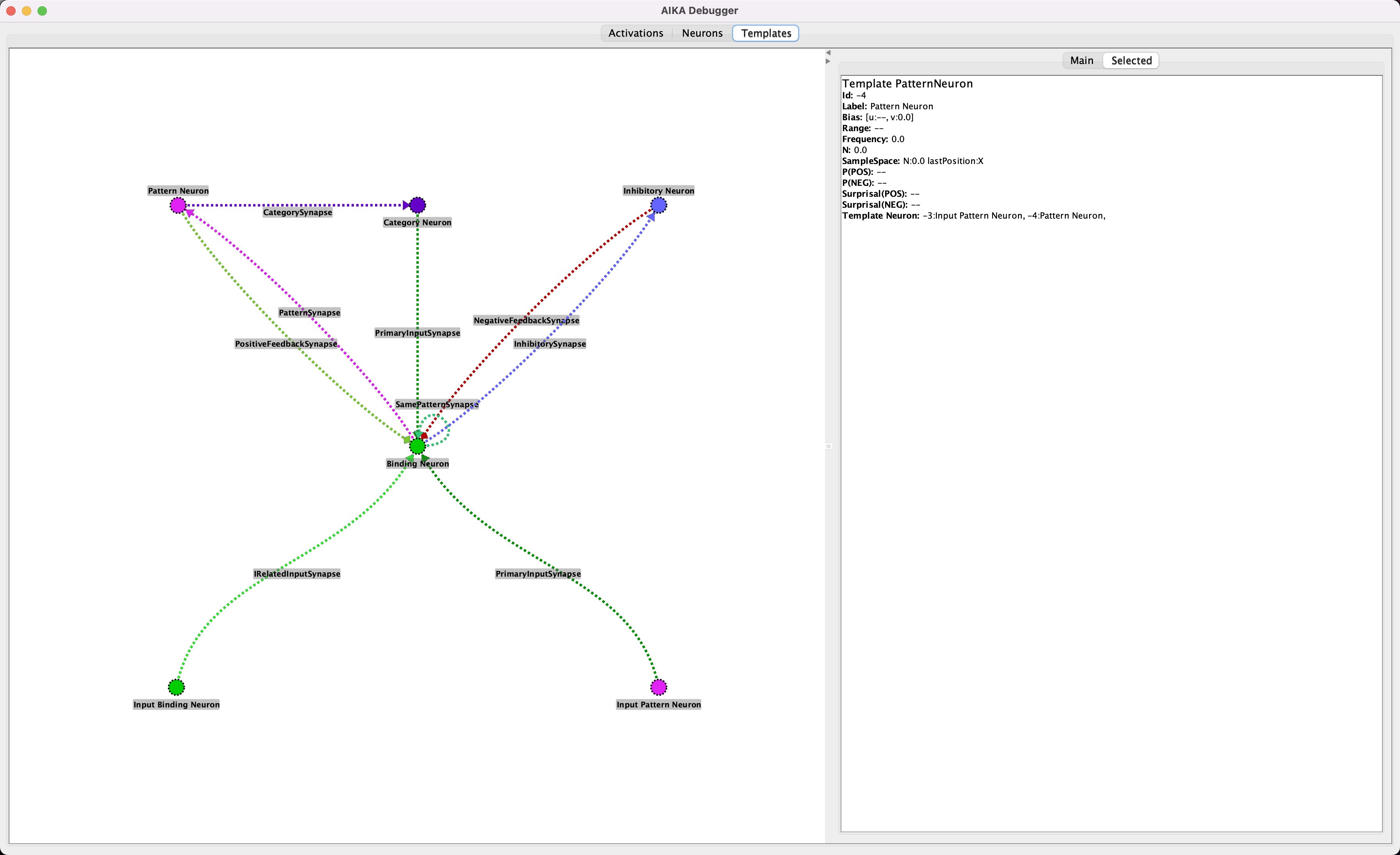
    @Test
    public void testABCD() throws InterruptedException {
        TextModel m = new TextModel();
        m.init();
        Templates t = m.getTemplates();

        PatternNeuron a_IN = m.lookupToken("a");

        PatternNeuron b_IN = m.lookupToken("b");
        BindingNeuron b_PTRelBN = TextModel.getPreviousTokenRelationBindingNeuron(b_IN);

        PatternNeuron c_IN = m.lookupToken("c");
        BindingNeuron c_PTRelBN = TextModel.getPreviousTokenRelationBindingNeuron(c_IN);

        PatternNeuron d_IN = m.lookupToken("d");
        BindingNeuron d_PTRelBN = TextModel.getPreviousTokenRelationBindingNeuron(d_IN);


        // Pattern ab
        BindingNeuron a_abBN = createNeuron(t.BINDING_TEMPLATE, "a (ab)");
        BindingNeuron b_abBN = createNeuron(t.BINDING_TEMPLATE, "b (ab)");

        createSynapse(t.RELATED_INPUT_SYNAPSE_TEMPLATE, b_PTRelBN, b_abBN, 10.0);
        createSynapse(t.SAME_PATTERN_SYNAPSE_TEMPLATE, a_abBN, b_abBN, 10.0);

        createSynapse(t.PRIMARY_INPUT_SYNAPSE_FROM_PATTERN_TEMPLATE, a_IN, a_abBN, 10.0);
        updateBias(a_abBN, 2.5);

        createSynapse(t.PRIMARY_INPUT_SYNAPSE_FROM_PATTERN_TEMPLATE, b_IN, b_abBN, 10.0);

        PatternNeuron abPattern = initPatternLoop(t, "ab", a_abBN, b_abBN);
        updateBias(abPattern, 3.0);


        // Pattern bc
        BindingNeuron b_bcBN = createNeuron(t.BINDING_TEMPLATE, "b (bc)");
        BindingNeuron c_bcBN = createNeuron(t.BINDING_TEMPLATE, "c (bc)");

        createSynapse(t.RELATED_INPUT_SYNAPSE_TEMPLATE, c_PTRelBN, c_bcBN, 10.0);
        createSynapse(t.SAME_PATTERN_SYNAPSE_TEMPLATE, b_bcBN, c_bcBN, 10.0);

        createSynapse(t.PRIMARY_INPUT_SYNAPSE_FROM_PATTERN_TEMPLATE, b_IN, b_bcBN, 10.0);
        initInhibitoryLoop(t, "b", b_abBN, b_bcBN);
        updateBias(b_abBN, 3.0);
        updateBias(b_bcBN, 2.5);

        createSynapse(t.PRIMARY_INPUT_SYNAPSE_FROM_PATTERN_TEMPLATE, c_IN, c_bcBN, 10.0);
        updateBias(c_bcBN, 3.0);

        PatternNeuron bcPattern = initPatternLoop(t, "bc", b_bcBN, c_bcBN);
        updateBias(bcPattern, 3.0);


        // Pattern bcd
        BindingNeuron bc_bcdBN = createNeuron(t.BINDING_TEMPLATE, "bc (bcd)");
        BindingNeuron d_bcdBN = createNeuron(t.BINDING_TEMPLATE, "d (bcd)");
        createSynapse(t.RELATED_INPUT_SYNAPSE_TEMPLATE, c_bcBN, bc_bcdBN, 10.0);

        createSynapse(t.RELATED_INPUT_SYNAPSE_TEMPLATE, d_PTRelBN, d_bcdBN, 10.0);
        createSynapse(t.SAME_PATTERN_SYNAPSE_TEMPLATE, bc_bcdBN, d_bcdBN, 10.0);

        createSynapse(t.PRIMARY_INPUT_SYNAPSE_FROM_PATTERN_TEMPLATE, bcPattern, bc_bcdBN, 10.0);
        updateBias(bc_bcdBN, 2.5);

        createSynapse(t.PRIMARY_INPUT_SYNAPSE_FROM_PATTERN_TEMPLATE, d_IN, d_bcdBN, 10.0);
        updateBias(d_bcdBN, 3.0);

        PatternNeuron bcdPattern = initPatternLoop(t, "bcd", bc_bcdBN, d_bcdBN);
        updateBias(bcdPattern, 3.0);


        Document doc = new Document(m, "abcd");

        Config c = getConfig()
                .setAlpha(0.99)
                .setLearnRate(-0.011)
                .setInductionThreshold(0.1)
                .setTrainingEnabled(true)
                .setTemplatesEnabled(true);
        doc.setConfig(c);

        AIKADebugger debugger = AIKADebugger.createAndShowGUI(doc);

        ...

        doc.processTokens(List.of("a", "b", "c", "d"));

        doc.processFinalMode();
        doc.postProcessing();
        doc.updateModel();
    }